We do not use Google Analytics or any third-party tracking.
The only cookie we set (with your permission) is an anonymous ID to keep this site functioning.
Learn more.
Podcast
Tony Varley talks about the Birth of Fell Running on the Isle of Man
 Presented by:
ESTR Pod
Category: Podcast
Published on: September 15, 2026
Last updated: September 21, 2026
14 min read
Presented by: ESTR Pod
Category: Podcast Published: 15 Sep 2026
Updated: 21 Sep 2026 14 min read
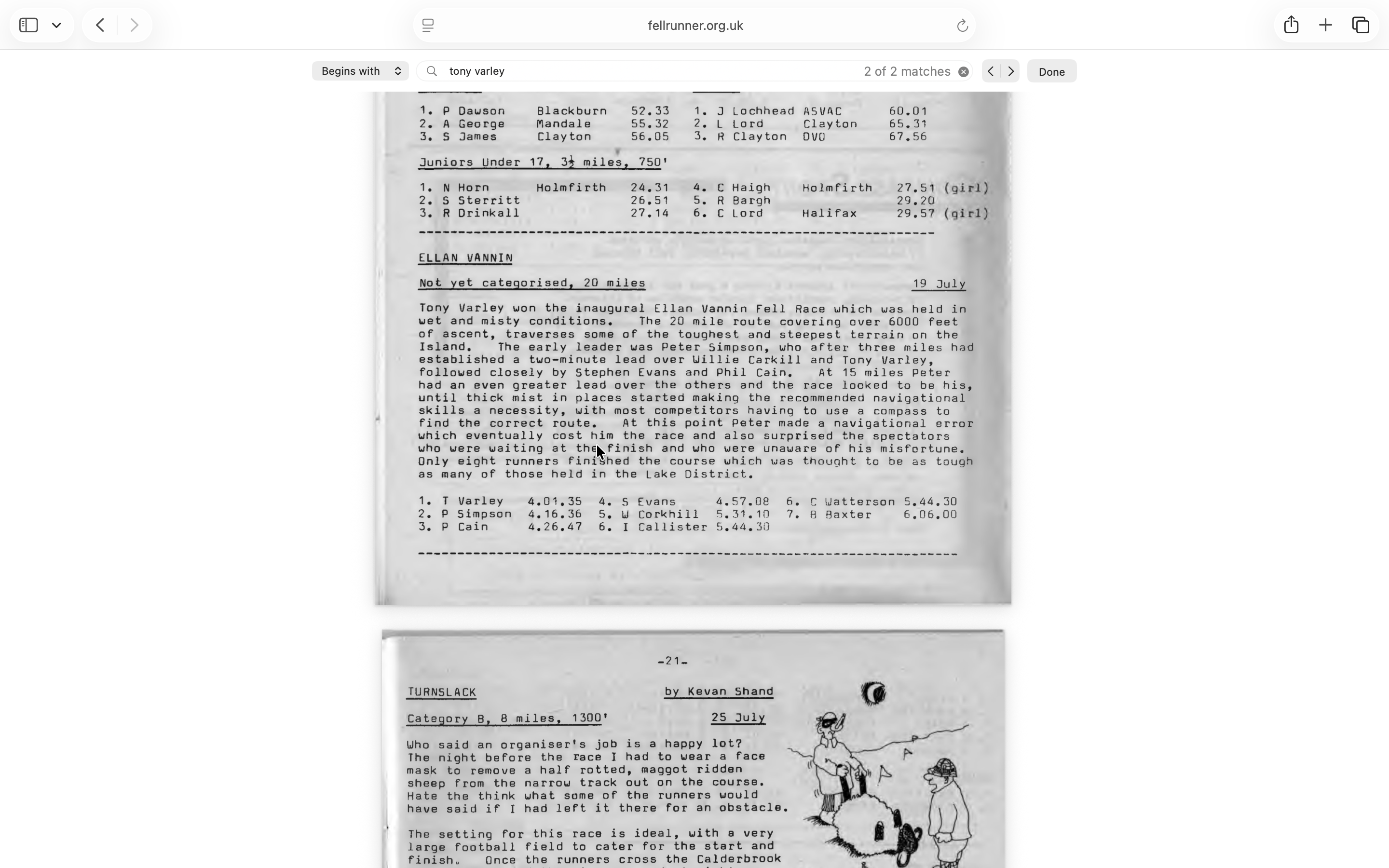
When Tony Varley first got into fell running on the Isle of Man, there were only three races. No club, no infrastructure, just Graham Davis asking if he wanted to give the Manx Mountain Marathon a go. That is how it started for him.
How it all began
Tony was not a runner when Graham got him involved. He was playing football and had just joined the fire service, which meant every other Saturday was a working day. But some of the good footballers on the island were doing cross country runs on Sundays to stay fit, and that is what inspired him. He saw Eddie Convery, the Peel footballer, playing his football match on the Saturday and then turning out for the cross countries, and he thought, I have got to do that too.
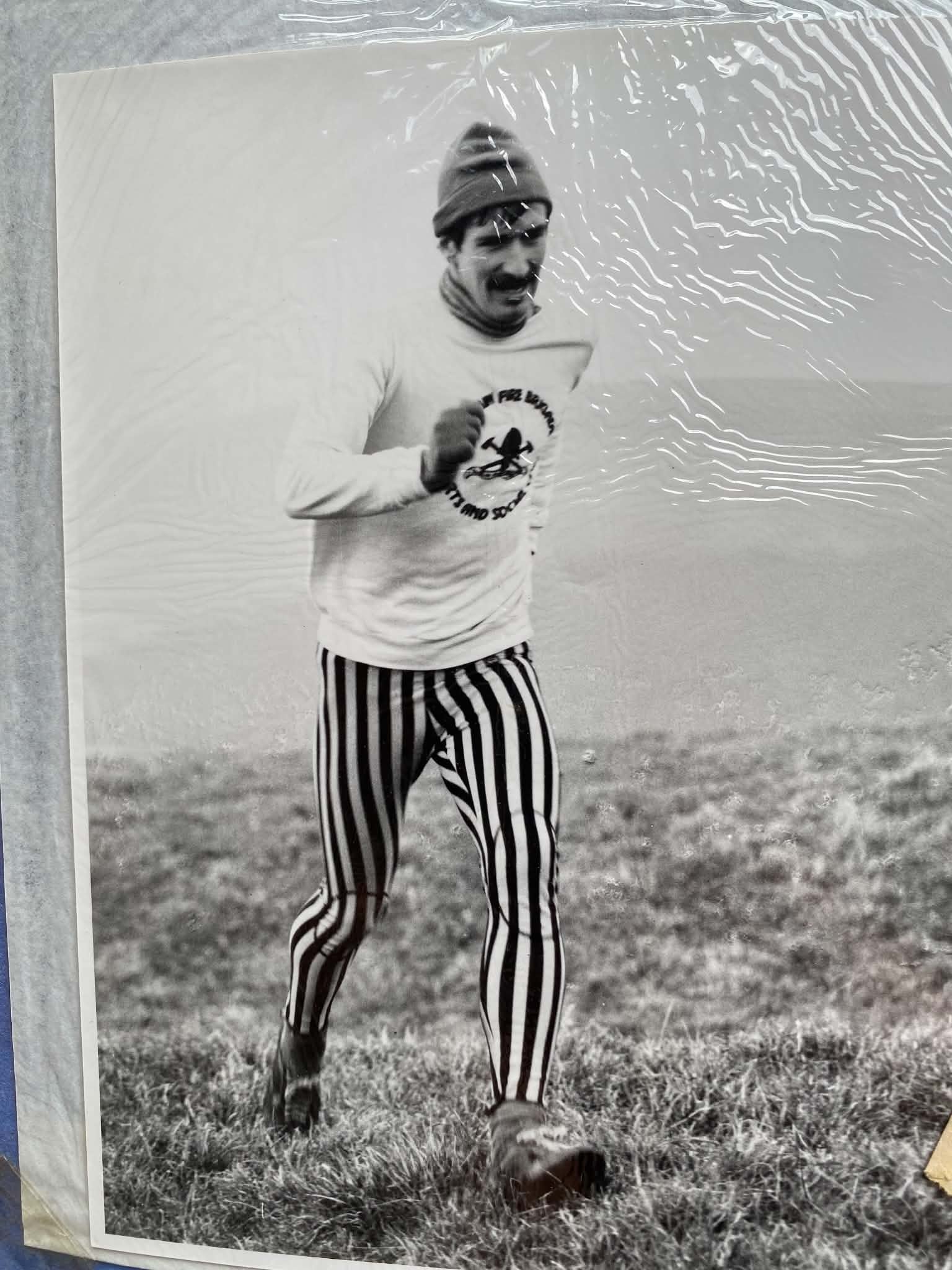
An early photograph of Tony in his running kit from the mid-1970s amateur athletics scene.
There were three established races back then: the Manx Mountain Marathon, the Laxey Horseshoe, and the Bradda Fell Race. They were organised by the Manx Mountain Marathon organisation, with Arthur Jones as secretary and George Broderick as president. Before that, Arthur had run a hostel-to-hostel event from the Axen Fell Hostel down to Port Erin. When Tony did his first mountain marathon in 1976, he had barely trained.
The mountain marathon had different standards: walkers, silver standard, and elite. The walkers could take well over ten hours. It was always held on Easter Monday, the highlight of the Easter festival, with a Friday night road race, a hill race on the Saturday, relays on the promenade, and then the Manx Mountain Marathon to finish it all off. The presentation was always at the Villiers Hotel, roughly where Conister Bank now stands. It was fantastic.
I'm going up there on my hands and knees, and here's this guy Joss Naylor leading the elite fell runners, this scrawny guy running up there. I was in awe of him. That's how I got hooked.
Tony
Joss Naylor was the man who hooked Tony on the sport. A Cumbrian farmer, famous for completing the Bob Graham Round, Naylor won that first Manx mountain marathon and was simply unbelievable to watch. Tony finished second or third local, but by the end he had fallen in love with the sport, and the following year he came back determined to do it properly.
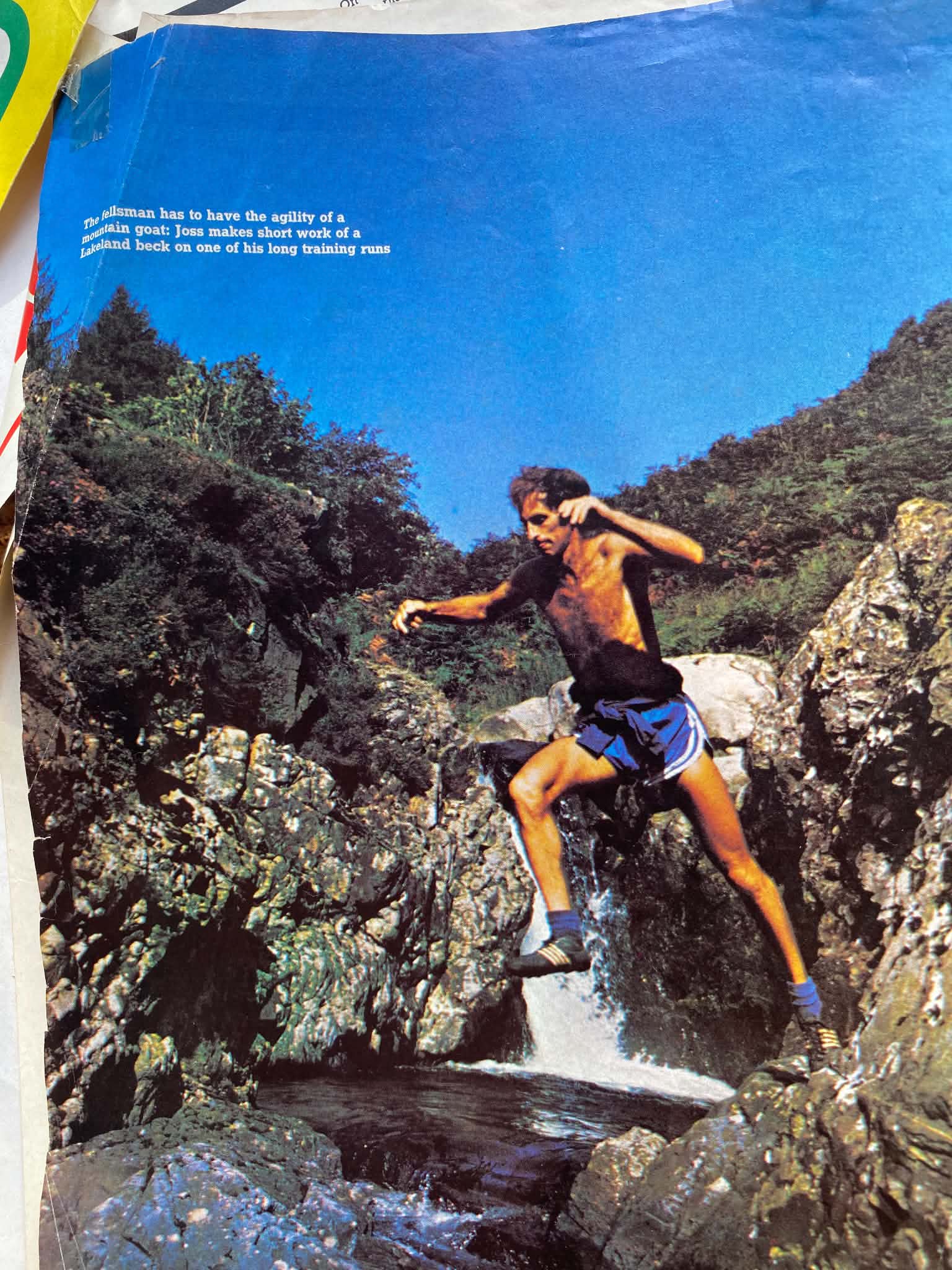
Joss Naylor training on a Lakeland beck, pictured in a magazine feature on the runner whose performance at the Manx Mountain Marathon first hooked Tony on fell running.
Training and kit from the 1970s
There were not many Manx runners on the fells back then. Tony remembers running with Mitch Joughin, Alan Corlet, Mike Grey, Ian Callister, Murray Lambden, Steve Kelly and Dave Newton, although runners full stop were thin on the ground. Manx Harriers club nights ran on Mondays and Wednesdays with maybe eight or ten people. If you were a runner, you were a runner. Nobody jogged for fun. Everyone did cross country, and some tackled the Bradda Fell Race or the Laxey Horseshoe too, posting good times even though they were predominantly road runners.
Runs would start from the Manx Harriers clubhouse on Drink Water Street, followed by a pint at the Foresters and chips afterwards. That is how Tony got to know Steve Kelly, who got into the fells the same way he did, hooked on it. It is a completely different sport from road running. Tony loved the mystical nature of it, being able to pick your own route from point to point. You could get lost in the mist, so you needed to know the terrain or risk going well off course.
For kit, Tony was given a cycling T-shirt, possibly by Richie or Mark Gage, who was a cyclist. You could tuck a compass and map into it, and that was the nearest thing to proper running kit at the time. There were no bum bags back then. Runners wore big race numbers like windmills, so people did not need glasses to see them, held on with about twenty safety pins. A tailwind helped; a headwind dragged you down.
To be honest with you, what I got was a cycling T-shirt someone gave me. And I don't know if it was Richie because he used to cycle or Mark Gage as he was a cyclist at the time too.
Tony
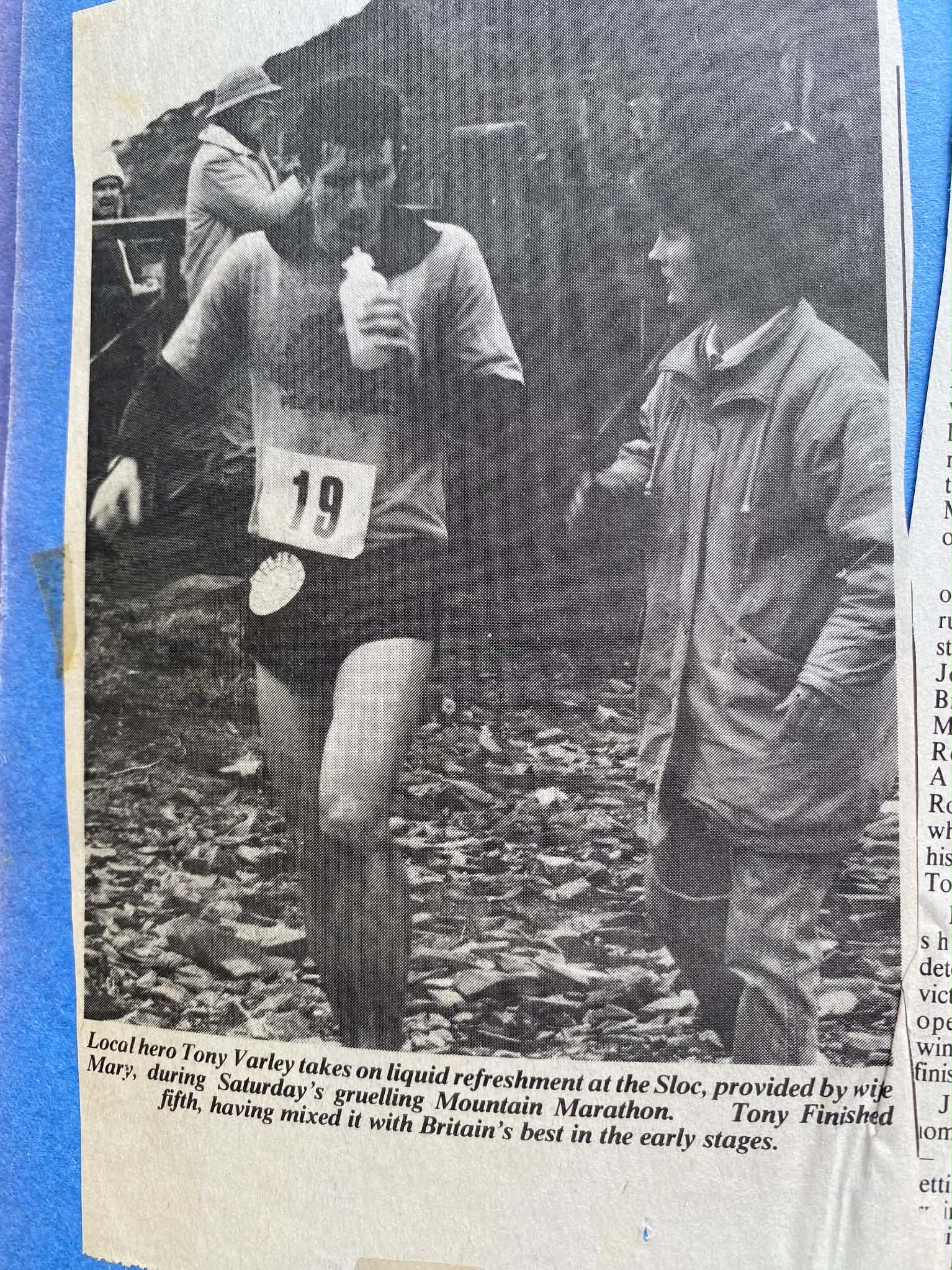
Tony takes on a drink at the Sloc, during a Mountain Marathon in which he finished fifth after mixing it with some of Britain's best in the early stages.
The main shoes were Walshes. In the Lakes there were runners like Billy Bland, renowned names in the sport. The island never managed to get them over to do the mountain marathon, which was a shame, though plenty of phenomenal runners did come over from the Lakes and beyond.
Legendary visitors and coaching weekends
The Manx Mountain Marathon was part of the British Championships, which brought the top runners over and raised the level of competition. Once these runners were known, they were invited back for coaching weekends. Jeff Norman went to the Moscow Olympics off the back of a 2:12 marathon. Dave Cannon from Appleby had won the British fell running championship and run a 2:10 marathon. Unbelievable athletes.
Dave Cannon had the group up at Windy Corner doing downhill reps, not uphill. He was selling Asics shoes at the time and had an inner sole he demonstrated by dropping an egg down onto it without it breaking, presumably trying to get everyone to buy the shoes. About ten runners turned up at Windy Corner to do the reps down, and you could see the logic in it, since steep downhill running is where the eccentric loading comes in.
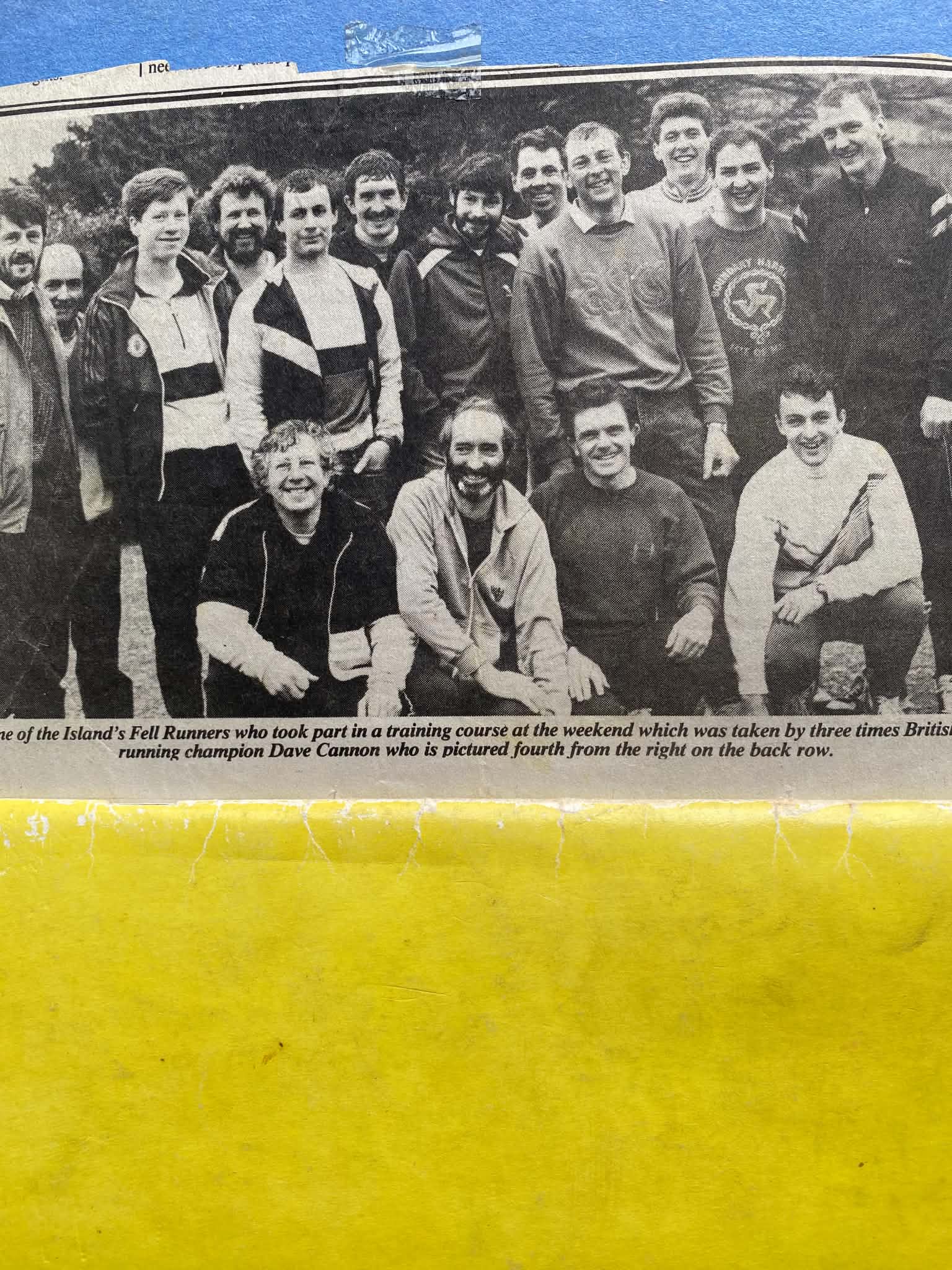
The island's fell runners pictured at the training weekend led by three-times British fell running champion Dave Cannon, fourth from the right on the back row.
Colin Donnelly, who was in the RAF, used to train with Steve Jones, winner of the Chicago Marathon in 2:08. Donnelly had a real passion for the fells. He had done all the Munros, and when he ran the Manx Mountain Marathon, he set the record at four hours and two minutes. Tony told John Watson it was probably the best athletic performance he had ever seen on the Isle of Man, knocking around twenty minutes off the previous best set by British champions before him.
Colin came over for the Laxey Horseshoe soon after and stayed with Tony. Tony picked him up from the boat at six in the evening, and Colin asked whether there was anything on that night. As it happened, there was the Peel road/trail race, now called the Dave Phillips, and he said he would not mind having a go. He went to Peel, went the wrong way, and still broke the course record, which turned out to be just his warm-up. He borrowed a bike and cycled the TT course the next day to have a look, then went for a swim at the Aquadrome on the Sunday morning before the Laxey race, where he simply took off. Tony looked at Alan Gage, a strong runner himself at the time, and said, what is this guy? Donnelly went on to take 12 minutes off Chris Quine's record on the 12 mile course, and two weeks later took a silver medal at the world hill running championships in Italy.
What amazed Tony about all these runners was how unassuming they were. In most sports, the people at the very top of their game just get on with it. They do not make a fuss. That is what he liked about them.
Making headlines
While all of this was going on, Tony was building a serious racing record of his own. Local newspaper cuttings from the period tell the story of a runner just as capable of winning outright as he was of helping others.
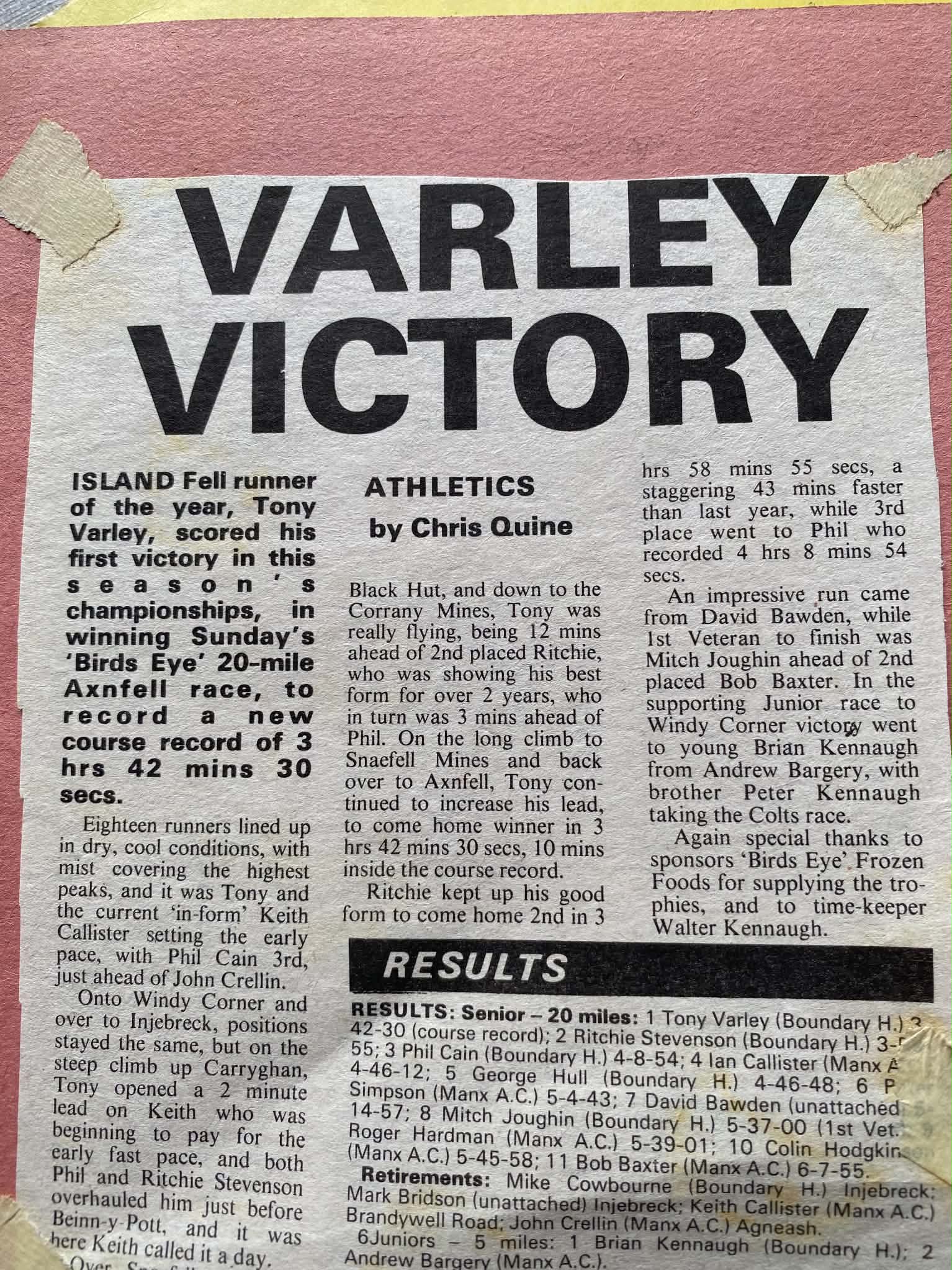
- Axnfell 20-mile course record | As island fell runner of the year, Tony won the Birds Eye sponsored Axnfell 20-mile race in a new course record of 3 hours 42 minutes 30 seconds, having pulled clear on the climb up Carryghan and held his lead all the way to the finish.
- Third overall in the Manx Mountain Marathon | Tony took third overall in the elite section of the Manx Mountain Marathon, cutting seven and a half minutes off his own Manx record to regain the Snaefell Trophy, coming home in under 4 hours 50 minutes after overtaking Derek Radcliffe of Rossendale Harriers.
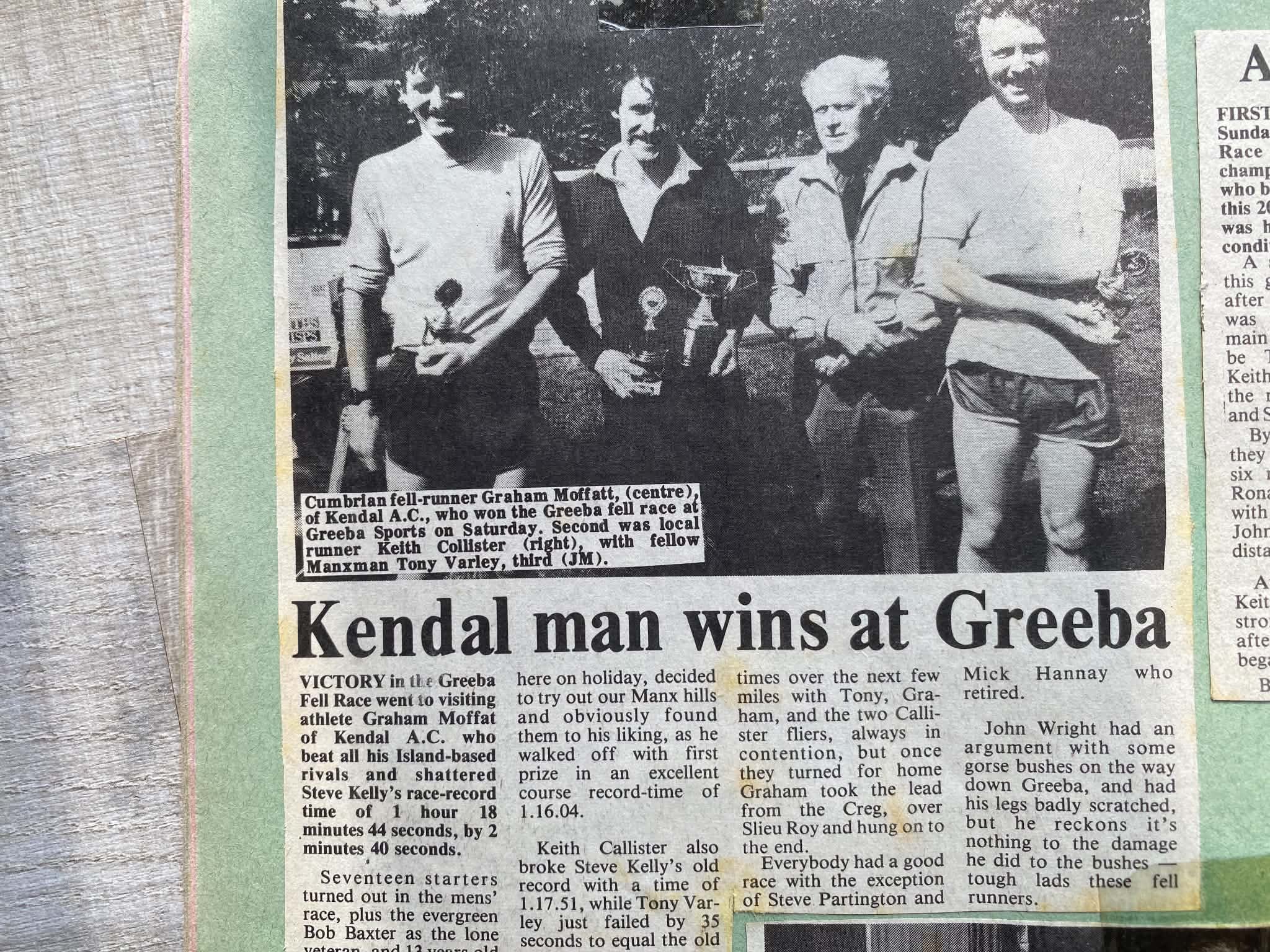
- Greeba Fell Race win | Tony won the nine-mile Greeba Fell Race in 1 hour 18 minutes 14 seconds, a personal best that came within two minutes of the course record, with Keith Callister second and Phil Cain third.
- Runner-up at Patrick | Returning after illness, Tony finished second in the Patrick Fell Race behind Donald Lee of Cumberland Fell Runners, holding off a group of chasing runners on the descent from South Barrule.
- Eighth at the South Duddon Valley Championships | Travelling to the Lake District with a Manx party of fell runners, Tony finished an excellent eighth in the South Duddon Valley Fell Race Championships, one of the strongest fields in Britain, with Phil Cain also recording his best form of the year.
- Isle of Man Courier fell running award | At the Isle of Man Athletic Association's annual awards, Tony, then a Douglas fireman, received the Courier shield for winning the fell running league, presented alongside Steve Kelly's award for the island's top road runner.
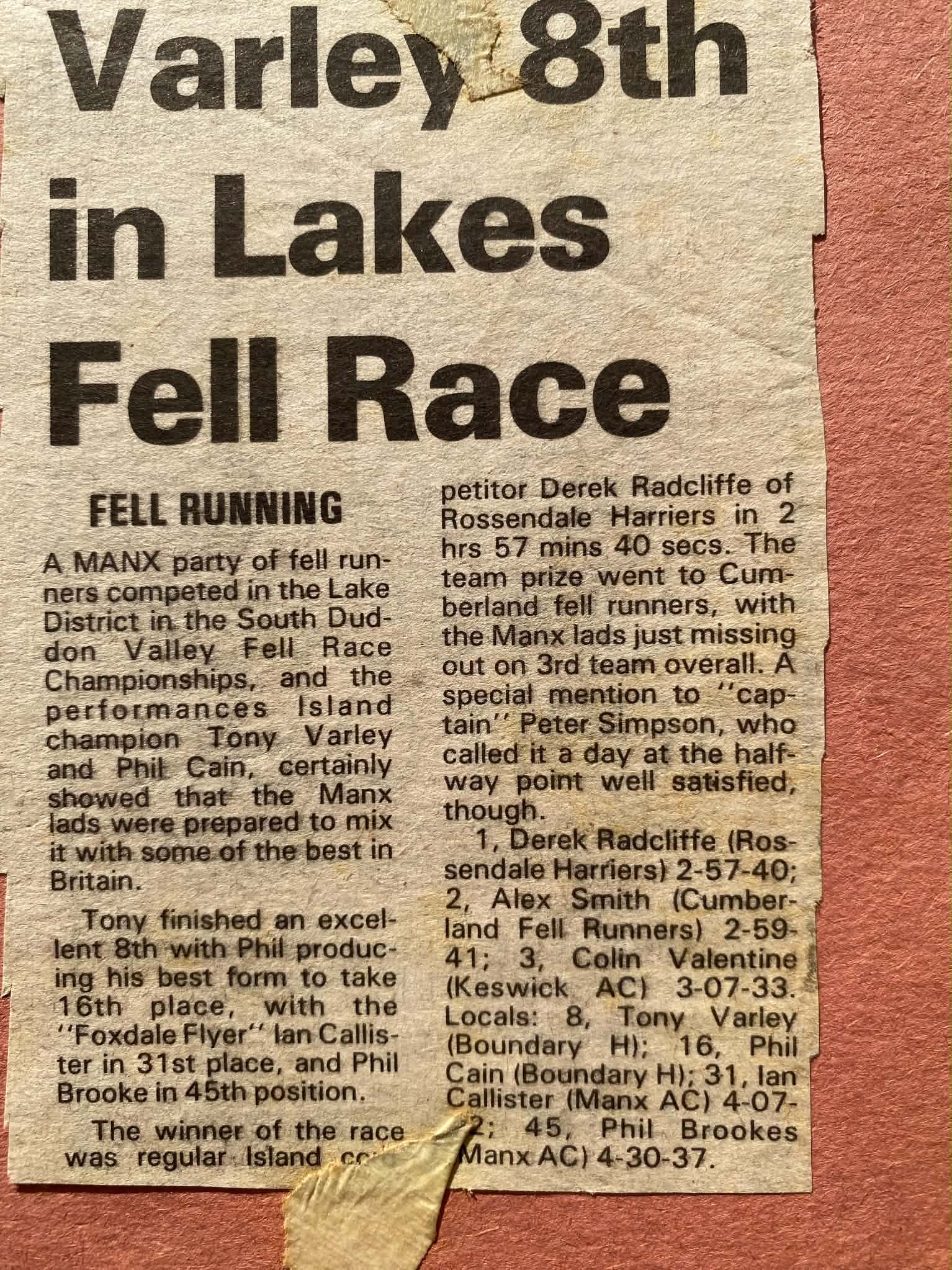
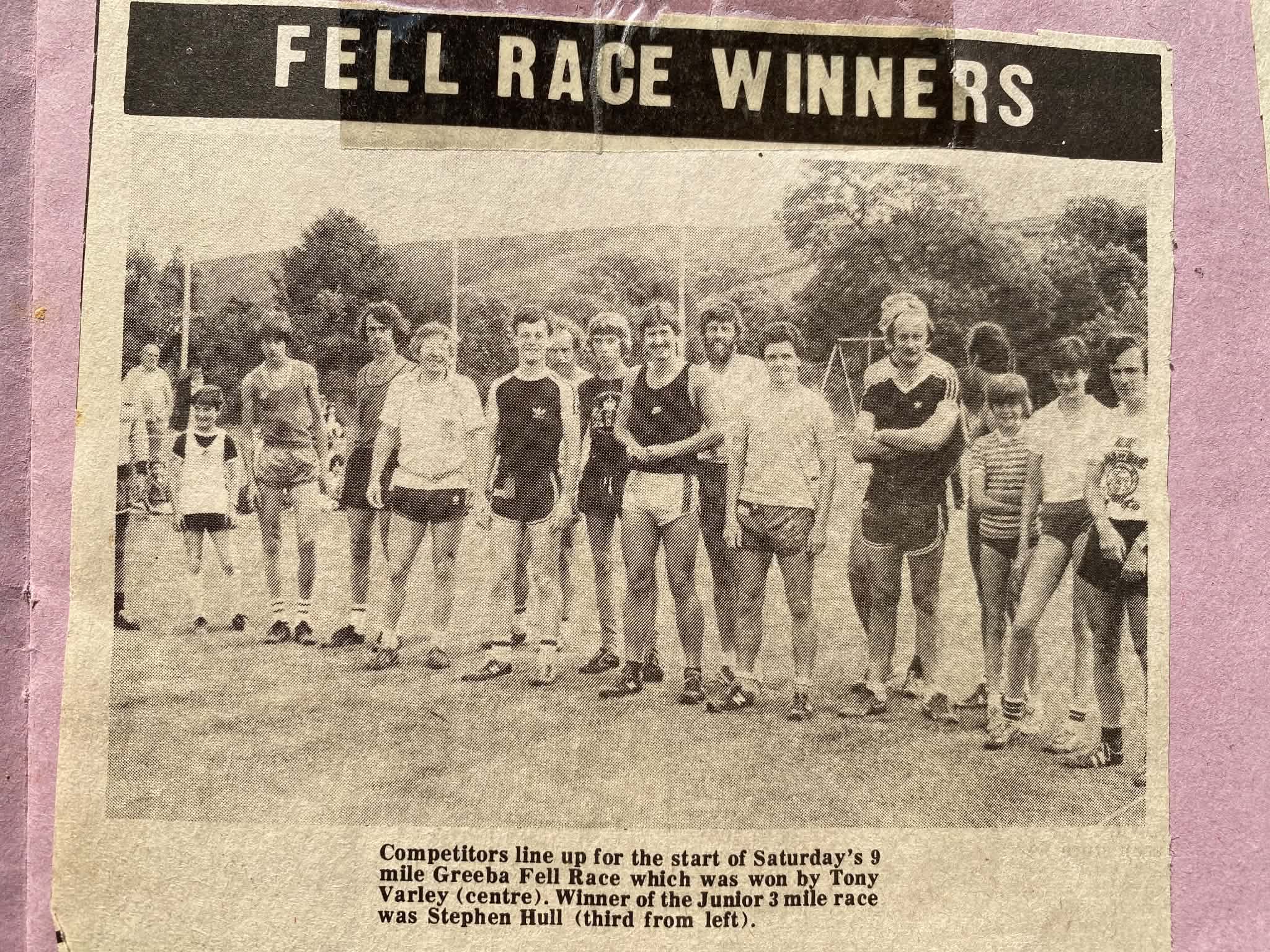
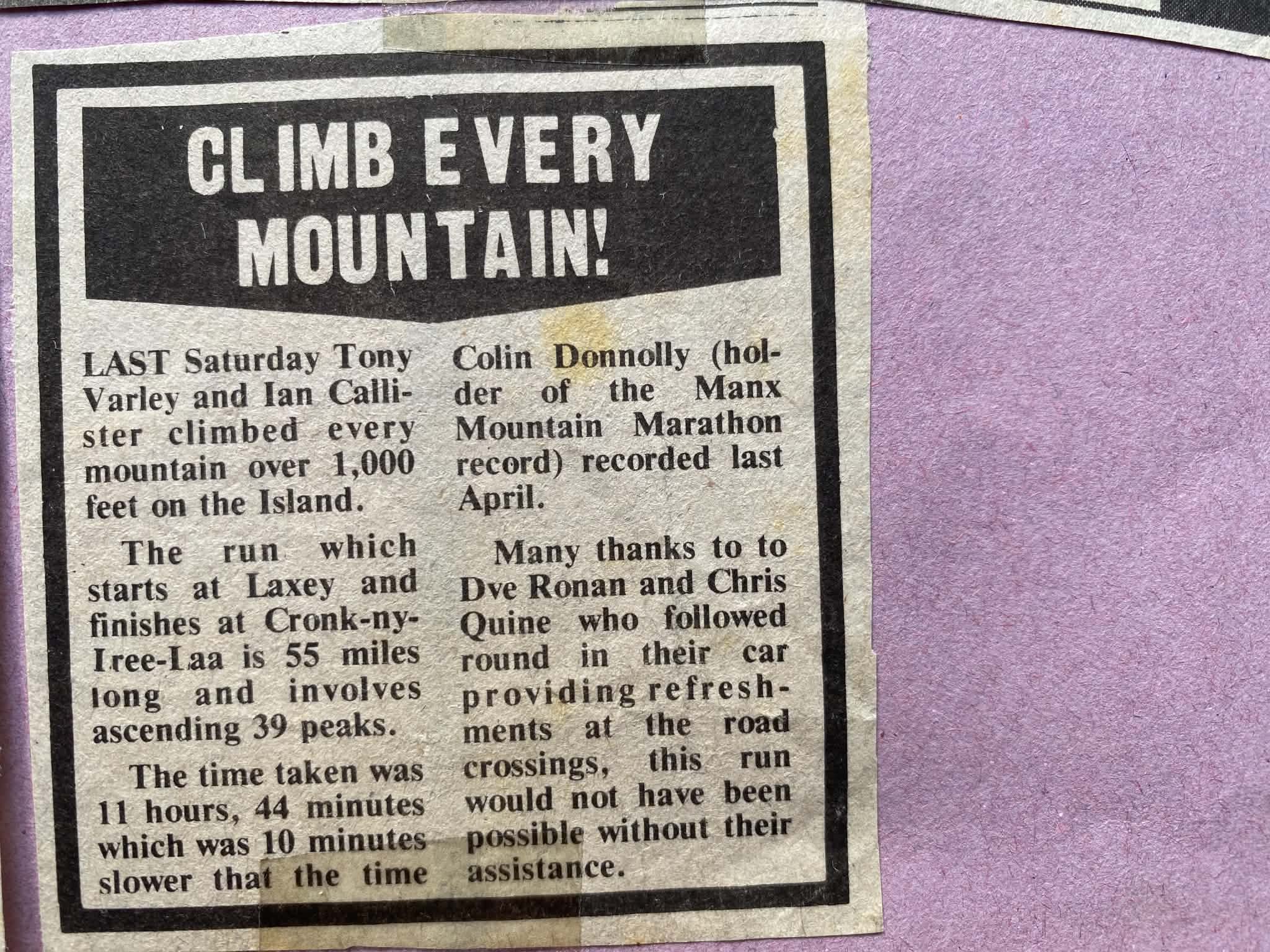
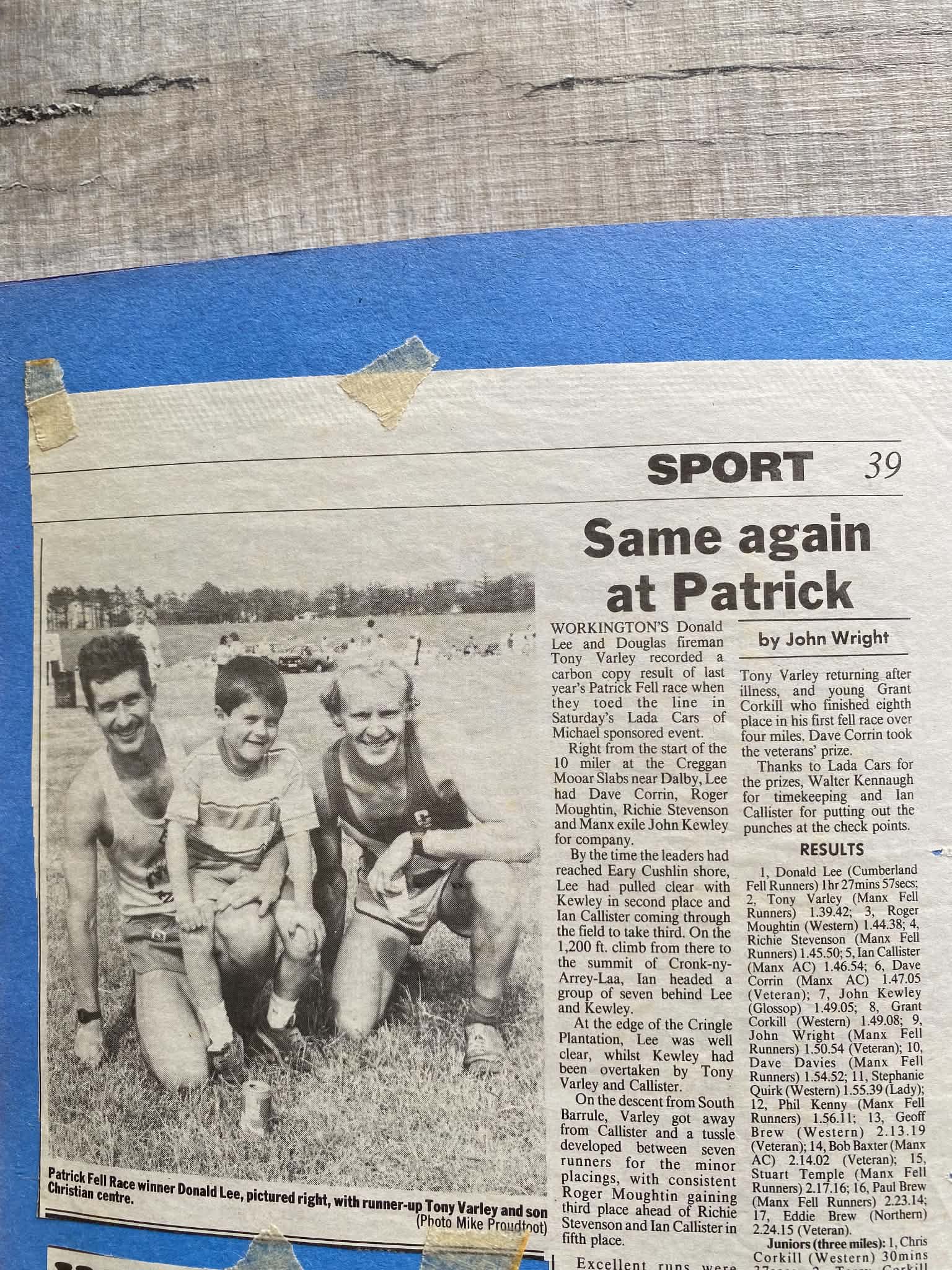
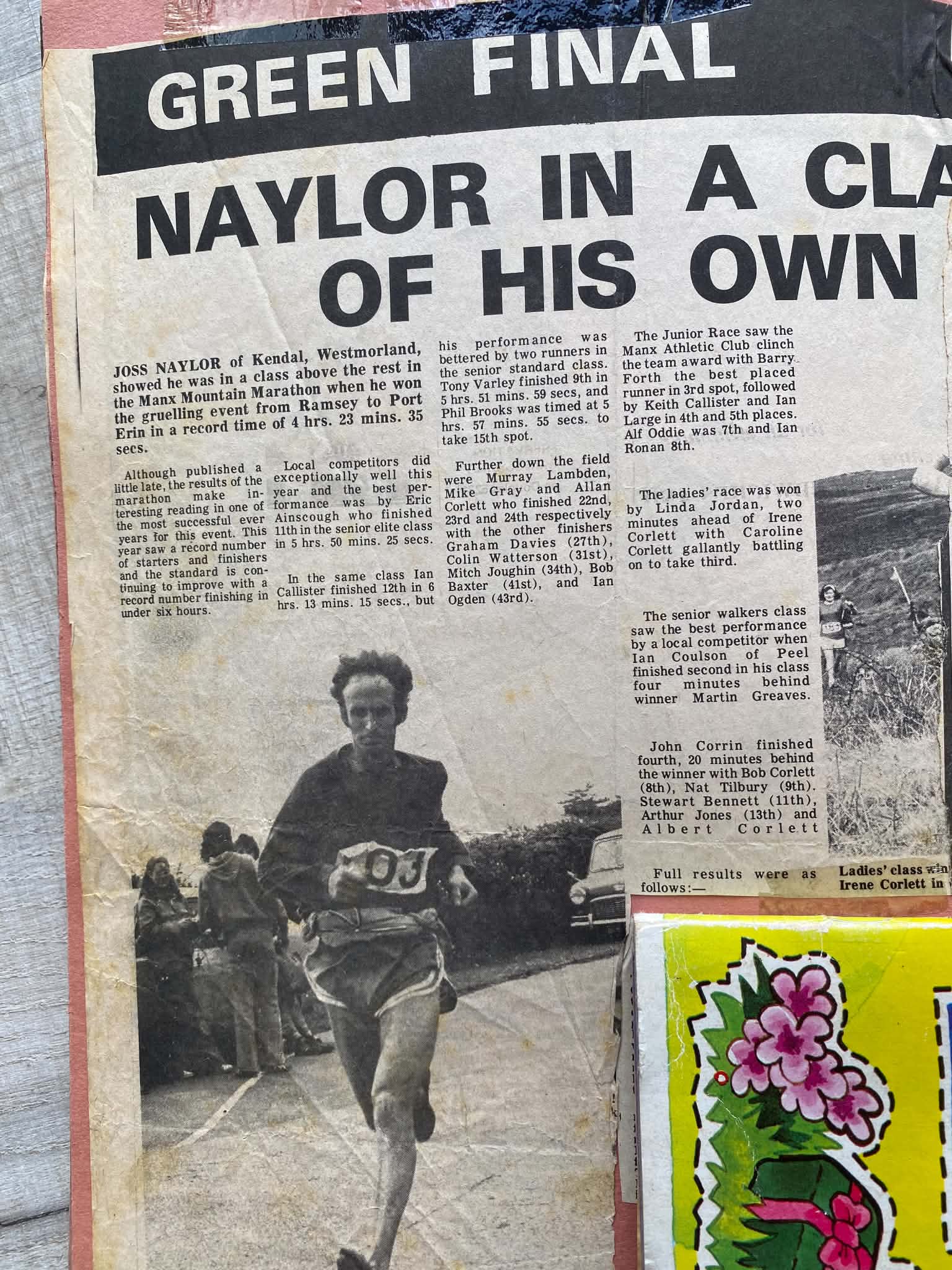
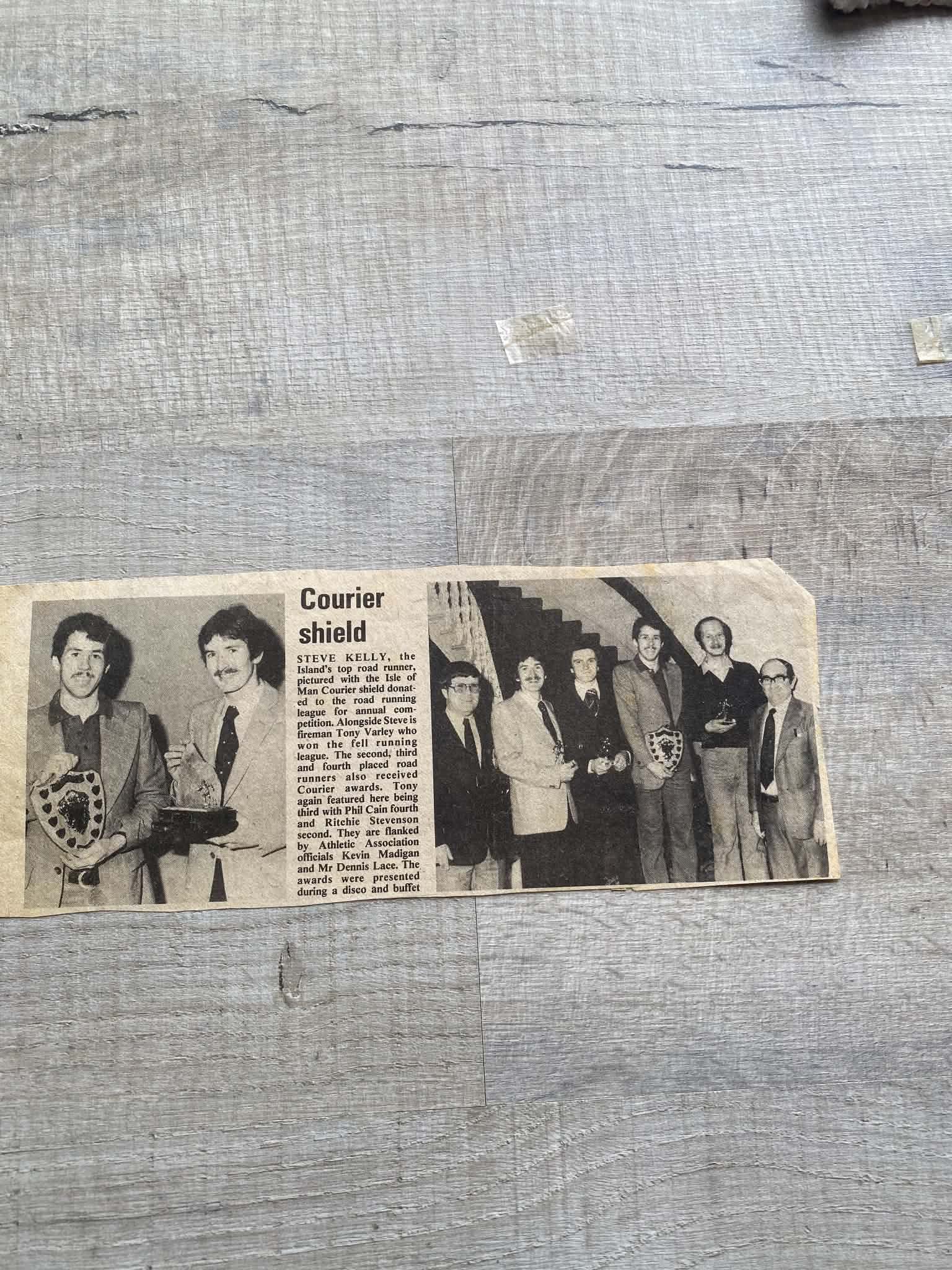
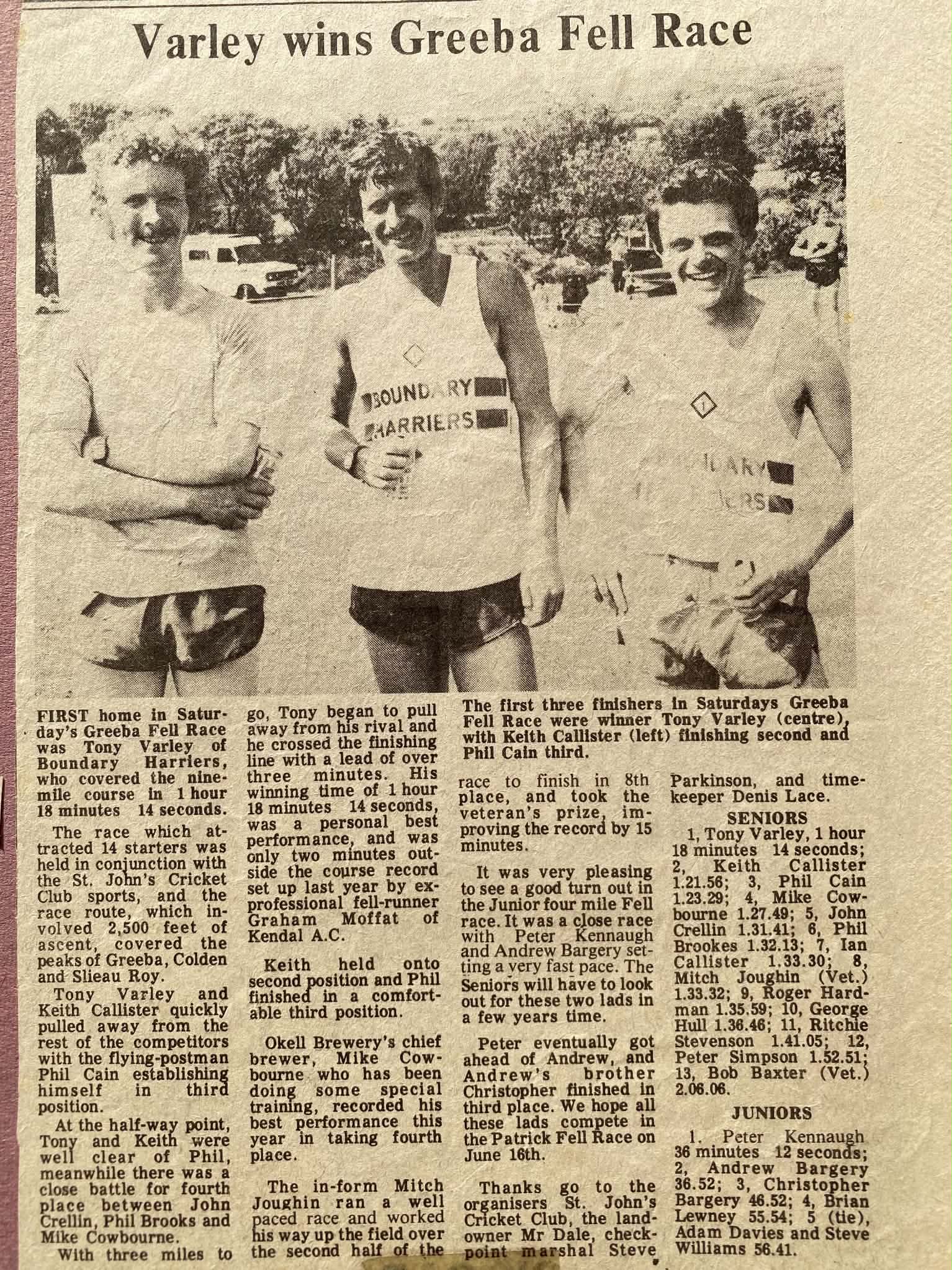
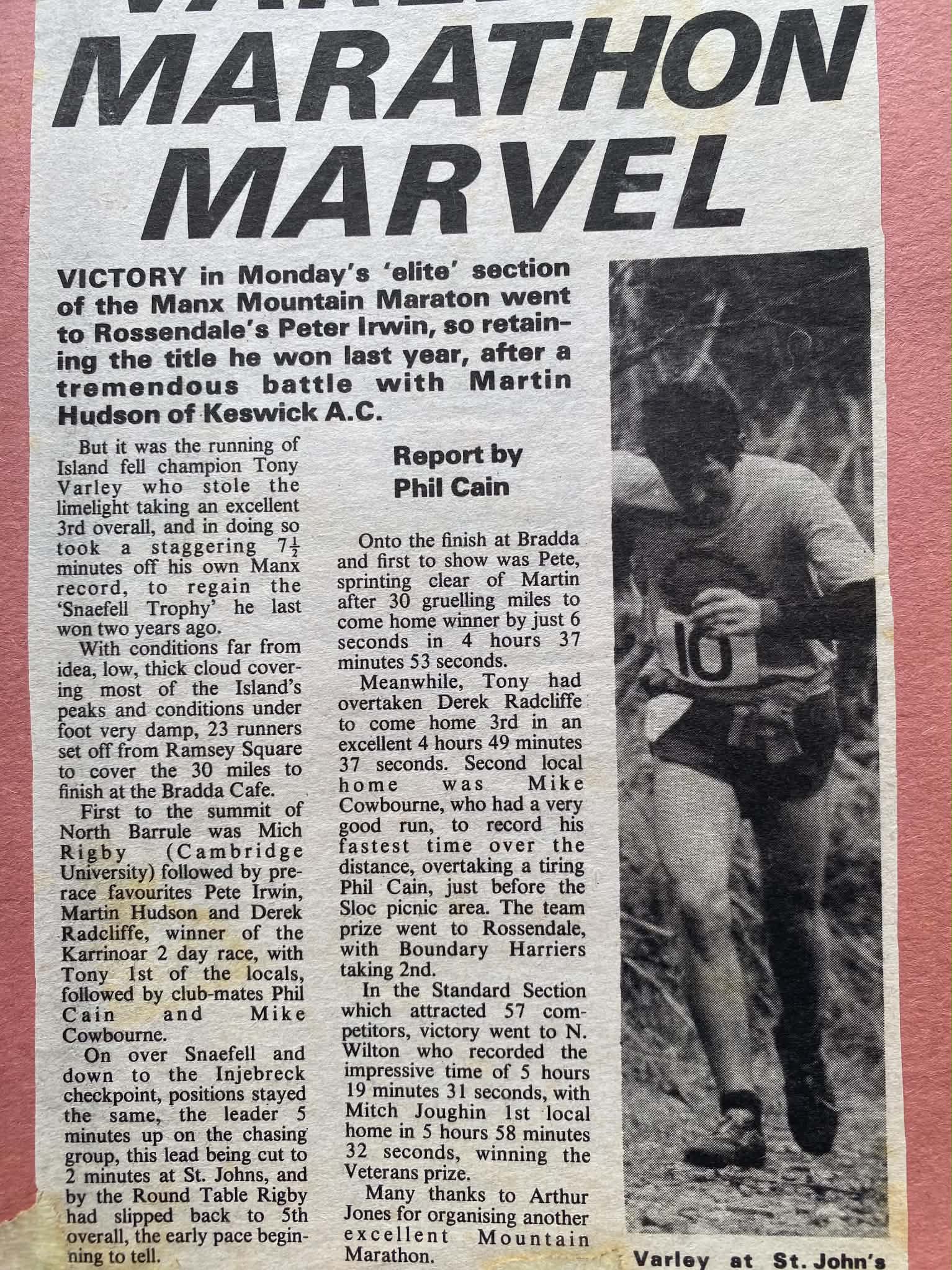
1 / 12
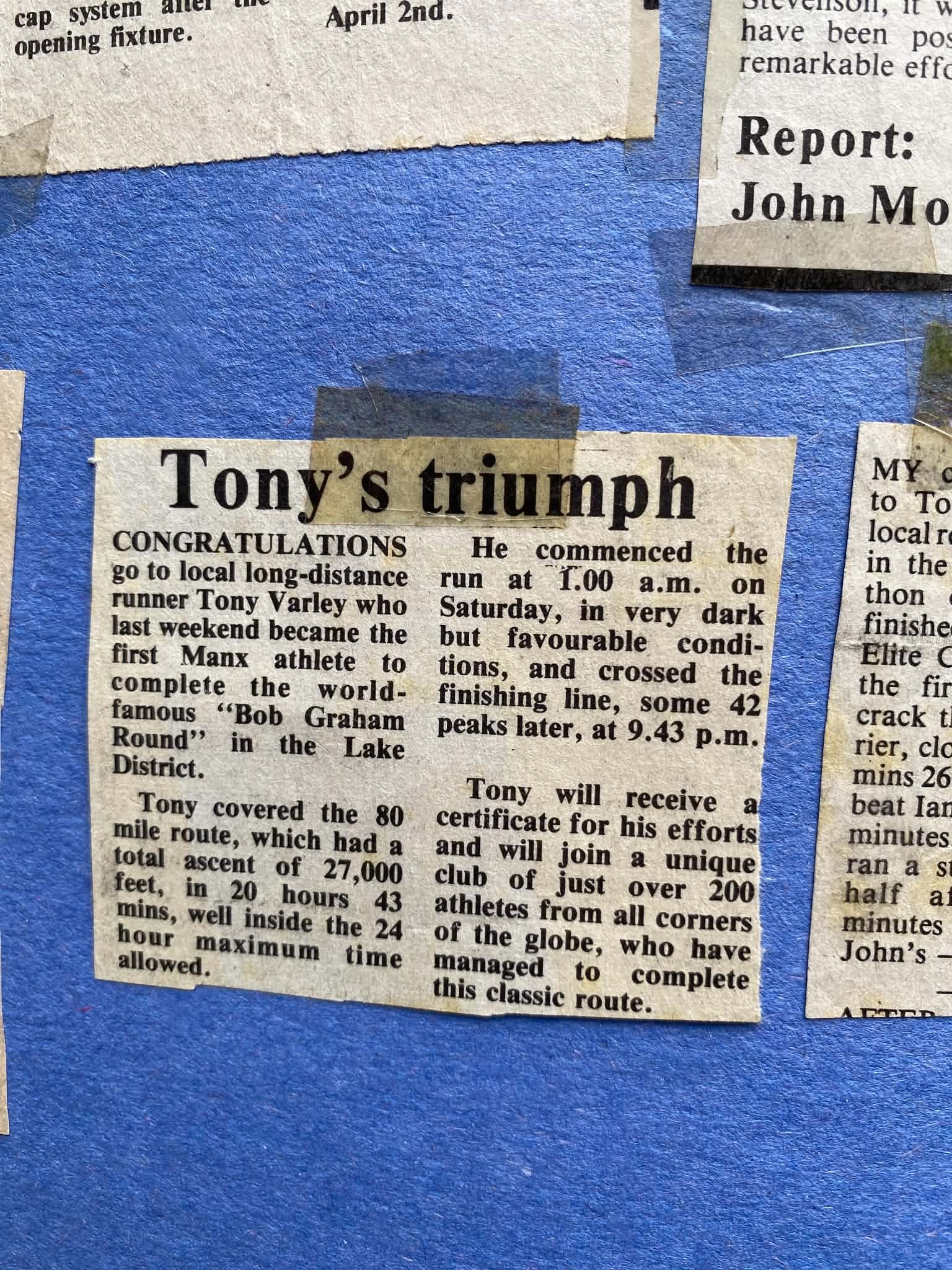
A selection of newspaper cuttings charting Tony's racing career through the late 1970s and 1980s, including his Axnfell course record, his Manx Mountain Marathon podium, and his Greeba Fell Race win.
Founding Manx Fell Runners
All of this happened before Manx Fell Runners even existed. The island had the Manx Mountain Marathon organised, but nothing catering specifically for fell runners. Tony and a few others felt the only way to improve was to build a proper identity for the sport. It was not a knock on the great people in the other clubs, Boundary Harriers, Manx Harriers, Western, Southern, but with five or six clubs on the island, none of them were focused on fell running.
The idea started around a table, probably in the early 1980s, before going to the Athletics Association. Arthur and Doug Brown, both great supporters, had to be persuaded, and there was resistance from people worried about losing members. Setting it up properly meant drawing up a constitution and getting in touch with the Fell Runners Association. Membership was small to begin with, really just a hardcore of a few people running under the Manx vest.
I thought the only way we're going to improve is you need your own identity. And it wasn't nothing against the great folk within all those other clubs.
Tony
Manx Fell Runners now has more senior members than any other club on the Island, and it is doing exactly what it set out to do: promoting fell running. It has a lovely atmosphere too. Everyone is friendly, and runners cheer on the people still finishing behind them. Everyone has their own goals, and simply getting round the course can vary hugely year to year depending on wind, rain, and conditions, on terrain that is completely different from the Lakes or Wales.
The Hill Search Team
After a few people got lost during the Manx Mountain Marathon, Tony asked Chief Fire Officer John Hinnigan whether they could form a hill search team. It was made up of volunteers from the Fire Service, initially 12 personnel from Douglas and four from Laxey. Having people from both stations was especially useful because it meant they could use vehicles with off-road capability. A team is still available to assist with incidents at any time.
That early initiative grew out of a practical need, but it also showed how much fell running depended on people looking after one another. The spirit of Tony's original hill search team can still be seen in the Island's modern inland search-and-rescue arrangements.
Today, searches can bring together the Isle of Man Constabulary, Fire and Rescue Service, Civil Defence, Coastguard teams and SARDA Isle of Man, whose volunteer handlers, dogs and navigators train for difficult terrain and missing-person incidents. Civil Defence volunteers train weekly, while Coastguard teams provide inland search support and off-road vehicles. SARDA's public call-out records show the range of situations involved, from missing walkers and runners to vulnerable people and casualties needing help in remote places. It is a lasting example of how a small group of volunteers can grow into a service that continues to protect the people using the Island's hills.
Further reading
The Bob Baxter and ultra-fell running
Ian Callister designed the Bob Baxter route on the Isle of Man, visiting all the peaks over a thousand feet. Colin Donnelly later returned to the island to complete the Bob Baxter round and stayed with Tony again, setting the record. Tony and Ian then completed the full round together themselves: 55 miles and 39 peaks, run from Laxey to Cronk-ny-Arrey-Laa in 11 hours 44 minutes, about ten minutes slower than Colin's record. The reporter Chris Quine and Dave Ronan followed the pair round by car, providing refreshments at the road crossings, without which Tony reckons the run would not have been possible. The group also organised a half Bob finishing at Snaefell, so the presentation could be held up there before taking the tram back down to Laxey. Tony got Bird's Eye, where his father worked, to sponsor it. They were good days, though not many people took part, one year there were only 12 entrants, and it is worth sparing a thought for the timekeepers who stood out there for hours.
When Tony went to do the full Bob Graham in the Lakes, he went with Martin Hudson, who had previously won the mountain marathon. Hudson was a very good orienteer and had won the Karrimor, similar to the OMM today. He had already done the Bob Graham solo in November, in snow, unbelievably. Tony had not recced the route properly and simply put his faith in Martin. They started at one in the morning to get a couple of hours of darkness out of the way, with daylight arriving as it was July.
Going up Skiddaw it was a calm night with the clouds sitting below them, like being on an aircraft. Then Martin went off course for about fifteen minutes on the very first peak, quite funny given he was probably the best orienteer in the country. The streams were dry, which was unexpected, and Tony was wearing road shoes and picking up blisters. Martin had car support, but they only saw it about twice, and the plan to grab drinks from the streams did not work out. They finished around half past nine, had fish and chips, a pint, and then got the boat back.
Tony's round is on record with the Bob Graham 24 Hour Club. His qualifying round is dated 16 July 1983, run clockwise, starting at one in the morning and crossing the finish line at 9.43 that evening, an elapsed time of 20 hours and 43 minutes. Along with Martin Hudson, he was also assisted by Ken Ledward and Dave Hollingway. It made Tony the first Manx athlete to complete the round, and his time placed him joint 30th out of the 278 rounds recorded up to that point, comfortably inside the top ten per cent.
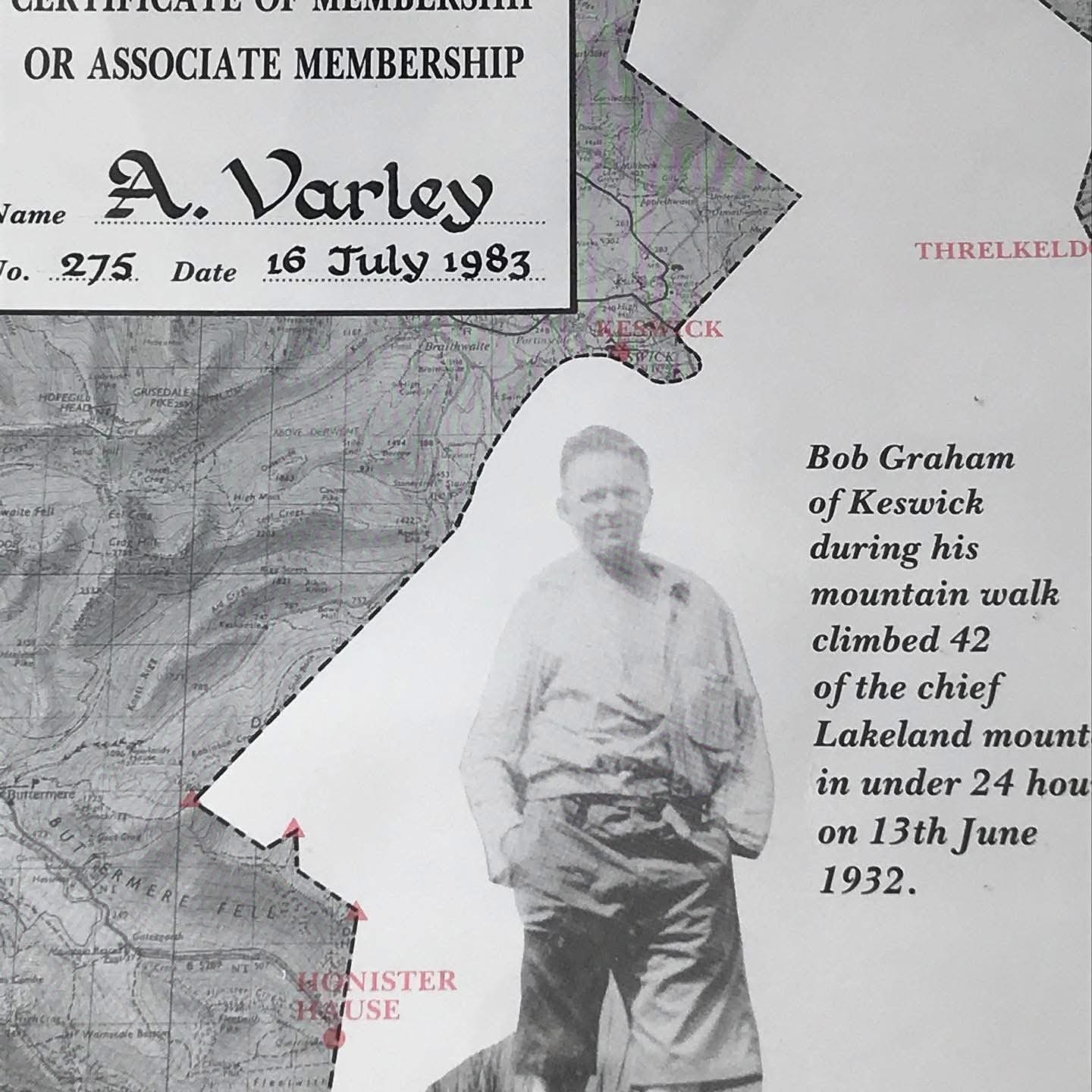
Tony's Bob Graham 24 Hour Club membership certificate, dated 16 July 1983.
Tony trained hard for the Manx Mountain Marathon, running 20 milers every Sunday and doing speed sessions around Nobles on Saturdays. But he got injured around the age of 32 with a hamstring problem that never really healed. In those days there was no emphasis on core strength, conditioning, or cross training. You picked up an injury and simply waited for it to repair itself, which was not ideal. Looking back, he would have got on an indoor trainer, gone swimming, done something else to keep the load off it.
Mountain biking came into it and took some of the load off. Brett McLendon was setting up the mountain bike club at the time, and on his first ride Tony could keep up uphill, though not so much downhill, which was strange given he had always been strong on the downhills in fell running. The group bought seven mountain bikes from Eurocycles. It was something different, and it also took him back to running in his favourite part of the island, around St Luke's especially. Fell running was always his main sport though, and it still is.
View the Bob Baxter routeIan Callister's Isle of Man round visiting the island's peaks over 1,000 feet.
View the Bob Graham routeTony's Bob Graham Round in the Lake District, shown alongside the island's Bob Baxter route.
Bob Graham Round — Tony Varley
Qualifying round16 July 1983Clockwise
Elapsed time20:4320 hours 43 minutes
DirectionClockwiseQualifying round direction
Start / finish1:00am → 9:43pm20 hours 43 minutes elapsed
Assisting runners3Martin Hudson, Ken Ledward and Dave Hollingway
Manx athleteFirstFirst Manx athlete to complete the Bob Graham Round
Recorded ranking30th / 278Joint 30th out of 278 rounds recorded at that point
Looking back on that period, Tony feels he would have benefited from putting less emphasis on mileage. The shoes were not great either, whatever Dave Cannon claimed, and there was little understanding then of core strength, conditioning or cross-training. With the benefit of hindsight, he would have used an indoor trainer, gone swimming or found another way to keep the load off his hamstring while it recovered.
He also remembers a useful speed session around Hope St John's when Margaret and Dave Lockley moved to the Island and formed a small local running group. Those sessions added variety and helped keep the training purposeful.
Tony is equally keen to recognise the people who helped Manx fell running grow. He remembers Ian Callister's help with the fell league, the many people who marked courses and put out the punches, and the hard work of Arthur Jones and George Broderick. He also gives special thanks to Richie and Tony for helping move Manx Fell Runners into the fabulous club it became, and to all the people who continue to make fell running friendly and successful. The welcome matters: when runners feel included, they come back, whatever their finishing time, because everyone has a story to tell.
Sources
Related links
Race calendar
Manx Fell Runners 2026/27
The current league dates in one clear reference.
| Date | Race | Season |
|---|---|---|
| Narradale 26/27 | 2026/27 | |
| Snaefell & More Tholtans 26/27 | 2026/27 | |
| St Johns - New Years Day 26/27 | 2026/27 | |
| Ard Whallan 26/27 | 2026/27 | |
| The Little Victory Fell Race 26/27 | 2026/27 | |
| Manx Half Mountain Marathon 26/27 | 2026/27 | |
| Manx Mountain Marathon 26/27 | 2026/27 | |
| James Coulson Laxey Fell race 26/27 | 2026/27 |